Essential but Not a Utility: Why Motor Carriers for Hire Occupy a Regulatory Gray Area

Share this Article:
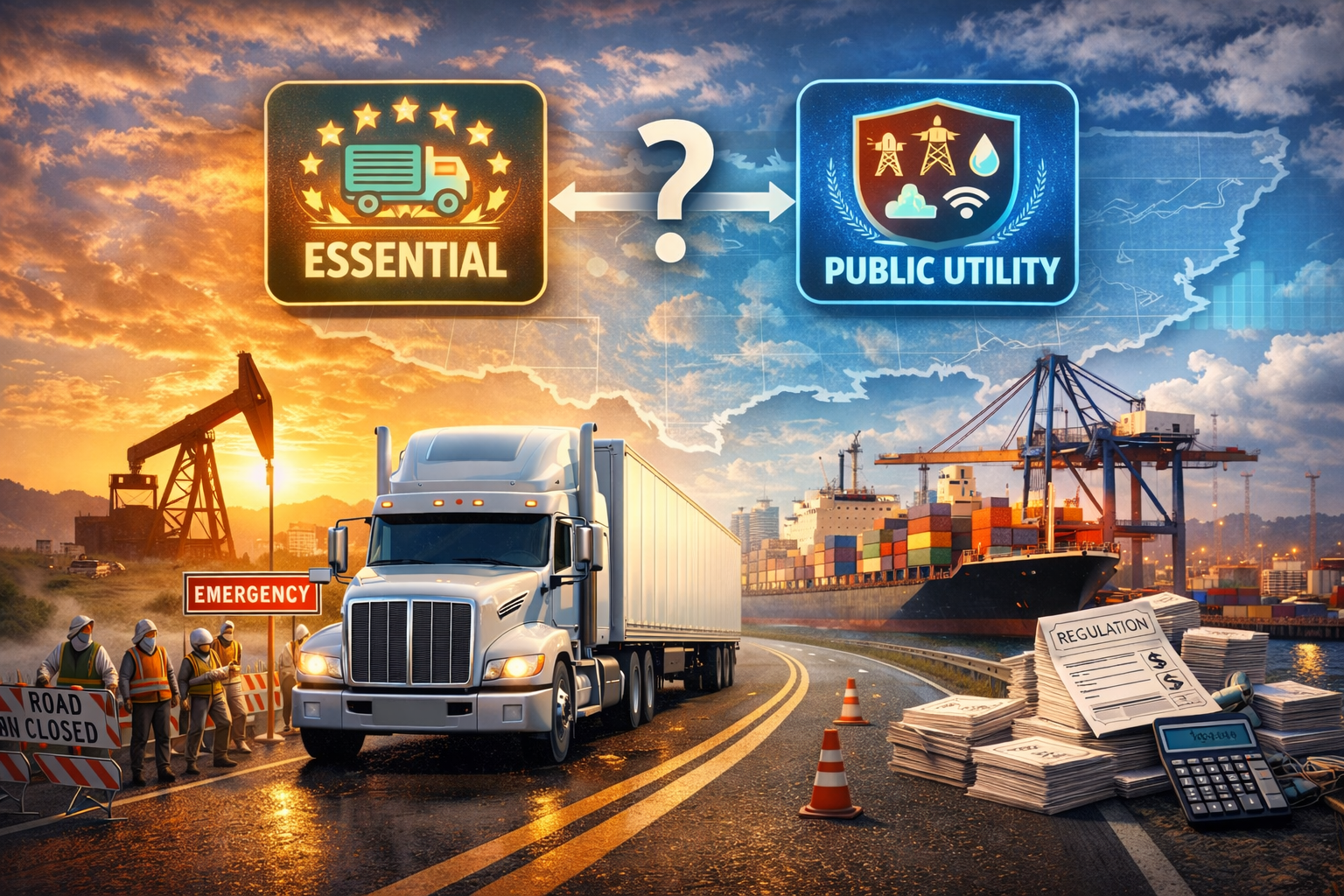
During the COVID-19 pandemic, government leaders across the United States delivered a clear message: motor carriers are essential. While offices closed and travel stopped, trucks kept moving. They delivered food, medical supplies, fuel, and consumer goods that allowed the economy—and daily life—to continue.

Yet once the crisis subsided, trucking returned to its familiar regulatory position: critical to society, but treated as a competitive service rather than a public utility. This contradiction raises an important question—especially in unidirectional states where freight flows heavily in one direction:


If motor carriers are essential, why are they not considered public utilities?


The answer lies not in the importance of trucking, but in history, law, and economic philosophy.


Motor Carriers Function as Essential Infrastructure


Motor carriers for hire form the backbone of the American supply chain. In unidirectional states—those shaped by ports, agriculture, energy production, or geographic constraints—trucking does far more than move freight. It sustains local economies, supports national commerce, and ensures access to basic goods.

These states often suffer from structural imbalances. Trucks haul freight in one dominant direction and return empty or underutilized. That imbalance increases costs, discourages market entry, and makes service less reliable during downturns.

Despite these challenges, motor carriers must still meet public expectations for reliability. Grocery stores must stay stocked. Hospitals must receive supplies. Manufacturers must ship products. Functionally, trucking in these states resembles a public utility—even if the law does not say so.


Essential Does Not Mean Public Utility


During COVID, governments used the word essential deliberately. The designation allowed drivers to keep working, relaxed certain compliance rules, and ensured access to fuel and infrastructure. It solved an immediate problem: keeping freight moving during an emergency.


Public utility status, however, creates permanent obligations. Utilities must:

  • Serve all customers in a defined area
  • Provide continuous service
  • Operate under regulated pricing
  • Accept limits on market exit


COVID policy addressed short-term continuity. Public utility classification would have required a permanent restructuring of the trucking industry. Policymakers avoided that step.


Deregulation Changed Trucking’s Legal Identity


Before 1980, interstate trucking looked much closer to a public utility. Regulators controlled:

  • Market entry
  • Routes
  • Rates
  • Service obligations


The Motor Carrier Act of 1980 dismantled that system. Congress chose competition over regulation, believing market forces would lower costs and improve efficiency. That decision permanently altered trucking’s legal status.


COVID did not reverse deregulation. It merely confirmed that deregulated carriers still perform an essential public function—without public utility protections.


Why Motor Carriers Are Not Treated Like Utilities

Several structural differences keep trucking outside the public utility framework:


No Obligation to Serve

Motor carriers may choose their customers, lanes, and freight. Public utilities cannot.


Market-Based Pricing

Trucking rates fluctuate with supply, demand, fuel, and capacity. Utility rates are regulated for stability and cost recovery.


No Infrastructure Ownership

Utilities own and maintain their infrastructure. Motor carriers rely on publicly funded highways they do not control.


Full Market Risk

Carriers absorb economic volatility, fuel swings, and downturns. Utilities recover costs through regulated rates.

These differences explain why policymakers resisted utility classification—even after calling trucking essential.


The Policy Contradiction COVID Exposed


The pandemic revealed a fundamental contradiction:

  • Motor carriers are too important to fail
  • Yet they receive none of the protections given to public utilities


During COVID, carriers absorbed extreme risk while keeping the economy running. Utilities, by contrast, benefited from guaranteed revenue mechanisms and regulatory certainty.

In unidirectional states, this imbalance becomes more pronounced. When carriers exit unprofitable lanes, communities feel the impact immediately. Supply chains falter. Costs rise. Access declines.


Why the Public Utility Debate Matters Now


The question is no longer whether trucking is essential—that point is settled. The real question is whether current policy appropriately reflects trucking’s role in the economy, especially where market forces alone fail to ensure reliability.


Recognizing motor carriers as public utilities does not require heavy-handed rate control or elimination of competition. It could mean:

  • Targeted protections in critical corridors
  • Policy frameworks that recognize structural freight imbalances
  • Regulatory consistency aligned with public benefit
  • Long-term investment stability for carriers serving essential markets


Conclusion


Motor carriers for hire occupy a unique space in the American economy. They operate as private businesses, but society depends on them like public utilities. COVID made that reality undeniable.

In unidirectional states and critical freight corridors, trucking already functions as essential infrastructure. The law simply has not caught up. As supply chains face growing strain, the conversation is shifting—from whether trucking is essential to whether policy should finally reflect that truth.

The future of transportation policy will depend on how—and whether—regulators resolve this tension.

Share with Us:

Two people in suits reviewing documents at a desk, one person uses a calculator.
February 4, 2026
Tax non-compliance in trucking leads to penalties, audits, and lost refunds. Learn how it impacts operations and growth.
Person in a suit reviews financial charts with a calculator and phone on a desk.
January 30, 2026
Learn how tax advisory helps transportation companies reduce risk, improve compliance, and uncover savings across multistate operations.
By Matthew Bowles January 14, 2026
The North American transportation industry enters 2026 carrying the scars of a prolonged freight downturn—but also the structural changes needed for recovery. After years of excess capacity, margin compression, and muted demand, the sector now shows clear signs of recalibration. Carriers have reduced fleets, shippers have adjusted sourcing strategies, and regulators continue to reshape compliance expectations. These forces converge in 2026, positioning the transportation industry for a measured but meaningful turn-around. This recovery will not resemble past freight booms. Instead, it will reward disciplined operators, data-driven decision-making, and companies that have restructured their cost bases during the downturn. The transportation companies that survive 2024 and 2025 emerge leaner, more technologically enabled, and better aligned with shipper expectations. Capacity Discipline Resets the Market The freight downturn forced capacity out of the system. Smaller carriers exited the market, owner-operators parked trucks, and larger fleets delayed equipment purchases. This contraction laid the groundwork for stabilization. By early 2026, the imbalance between supply and demand narrows substantially. Truckload capacity tightens first. Fleet bankruptcies and consolidations reduce overcapacity that plagued the market since 2022. Railroads, having already optimized precision scheduled railroading models, benefit from improved network fluidity and intermodal growth. Even last-mile and regional carriers experience steadier volumes as e-commerce normalizes at sustainable growth rates. Carriers that remain in operation in 2026 operate fewer assets but deploy them more efficiently. This discipline supports gradual rate improvement without triggering inflationary spikes. Shippers gain predictability, while carriers regain pricing power grounded in service reliability rather than desperation. Demand Stabilizes and Broadens Freight demand does not surge overnight, but it stabilizes across multiple sectors in 2026. Manufacturing reshoring and near-shoring initiatives continue to generate freight tied to domestic production rather than volatile overseas imports. Automotive, energy, and industrial materials lead early volume gains. Consumer spending shifts away from discretionary goods toward durable and essential products. This shift favors freight lanes tied to construction materials, food distribution, and industrial inputs. Retail replenishment cycles shorten, creating steadier, more predictable freight flows. Importantly, shippers move away from panic-driven overordering. Inventory strategies improve as companies integrate better forecasting tools and supply chain visibility. This change reduces extreme demand swings that previously destabilized carrier networks. Intermodal and Rail Gain Strategic Ground Rail and intermodal transportation play a central role in the 2026 recovery. Rising driver costs, environmental pressures, and congestion concerns push shippers to reconsider long-haul truckload dependence. Intermodal offers cost stability and emissions advantages that resonate with corporate sustainability goals. Railroads continue investing in terminal automation, crew optimization, and service consistency. These investments pay dividends as volume returns. Intermodal lanes expand beyond traditional coastal corridors, serving interior manufacturing hubs and distribution centers. For trucking companies, intermodal does not represent competition—it represents partnership. Drayage providers, regional carriers, and integrated logistics firms find new opportunities supporting rail growth. Companies that align truck and rail strategies position themselves for diversified revenue streams. Technology Separates Winners from Survivors The downturn forces transportation companies to confront inefficiencies they once ignored. By 2026, technology adoption moves from optional to essential. Carriers leverage telematics, route optimization, predictive maintenance, and real-time visibility to protect margins. Artificial intelligence and advanced analytics reshape pricing, network planning, and fuel management. Companies that invested early use data to anticipate demand shifts rather than react to them. Shippers reward these carriers with longer-term contracts and collaborative planning relationships. Back-office systems also mature. Automated billing, tax compliance tools, and audit-ready reporting reduce administrative burden. These improvements allow management teams to focus on growth rather than survival. Labor Pressures Ease but Do Not Disappear Driver availability improves modestly in 2026, but labor remains a structural challenge. Carriers benefit from reduced turnover as fewer competitors chase the same drivers. Improved scheduling, regional routes, and home-time predictability become retention tools rather than perks. Wage inflation moderates, but benefit costs and compliance obligations continue to rise. Companies that invested in driver engagement, safety programs, and technology-enabled workflows retain talent more effectively. Those that rely solely on pay increases struggle to compete. Management labor also tightens. Skilled dispatchers, safety professionals, and compliance specialists command premium compensation. Firms that train internally and build career pathways gain an advantage. Regulatory Complexity Shapes Strategic Planning Regulation does not slow in 2026. Instead, it becomes more targeted and data-driven. Environmental reporting, fuel tax compliance, and cross-jurisdictional audit activity increase. Governments leverage improved data systems to identify under-reporting and misclassification. Carriers and shippers respond by integrating compliance into strategic planning rather than treating it as a reactive function. Tax strategy, entity structuring, and transaction analysis become board-level discussions. Transportation companies that proactively address fuel tax exposure, sales and use tax risks, and multistate compliance protect margins during the recovery. Those that ignore these issues face audits that erase hard-earned gains. Mergers and Acquisitions Accelerate The recovery phase invites consolidation. Strong balance sheets, improved cash flow, and normalized valuations drive merger and acquisition activity in 2026. Strategic buyers pursue regional density, specialized equipment, and technology capabilities rather than raw scale. Private equity re-enters the market selectively. Investors favor companies with disciplined growth strategies, compliance maturity, and diversified customer bases. Transactions emphasize operational integration rather than financial engineering. For smaller carriers, acquisition offers an exit strategy after years of volatility. For larger platforms, consolidation strengthens negotiating power with shippers and vendors while spreading fixed costs across broader networks. Shippers Redefine Partnerships Shippers approach 2026 with lessons learned from supply chain disruption. They prioritize reliability, transparency, and collaboration over transactional rate shopping. Procurement teams shift from quarterly bids to multi-year partnerships tied to performance metrics. Transportation providers that demonstrate operational discipline and compliance credibility earn preferred-carrier status. These relationships support steady volume commitments that benefit both parties. Shippers also invest in internal transportation expertise. They understand tax exposure, regulatory risk, and modal strategy more deeply. This sophistication raises expectations for carriers but also creates opportunities for value-added services. Financial Health Improves Gradually The 2026 turn-around does not restore peak profitability immediately. Instead, margins improve incrementally as cost structures normalize and pricing stabilizes. Fuel price volatility remains a risk, but hedging strategies and surcharge mechanisms improve. Cash flow strengthens as bankruptcy risk declines and payment cycles stabilize. Lenders regain confidence, enabling refinancing and selective capital investment. Equipment purchases resume cautiously, favoring fuel-efficient and technology-enabled assets. Carriers that survived the downturn with disciplined balance sheets gain flexibility to invest in growth without overleveraging. A Different Kind of Recovery The transportation industry’s 2026 recovery reflects evolution rather than expansion. Companies succeed by applying lessons learned from adversity. They value data over intuition, discipline over speed, and partnerships over transactions. This turn-around favors organizations that invested during the downturn—whether in technology, compliance, people, or process improvement. The market rewards preparedness, not speculation. While uncertainty remains, the direction is clear. Capacity aligns with demand. Shippers stabilize volumes. Technology enhances execution. Regulation rewards transparency. Together, these forces create a foundation for sustainable growth. Conclusion: Preparing for the Turn-Around The 2026 transportation turn-around will not lift all participants equally. It will elevate companies that acted decisively during the downturn and challenge those that waited for conditions to improve on their own. Transportation leaders who plan now—by strengthening compliance, refining networks, investing in technology, and deepening shipper relationships—position their organizations to lead the next cycle. The recovery will arrive quietly, but its impact will be lasting for those ready to seize it. The question is no longer whether the transportation industry will turn around. The question is which companies will emerge stronger when it does.