Recover Hidden Cash with Transportation Tax Consulting LLC

Share this Article:
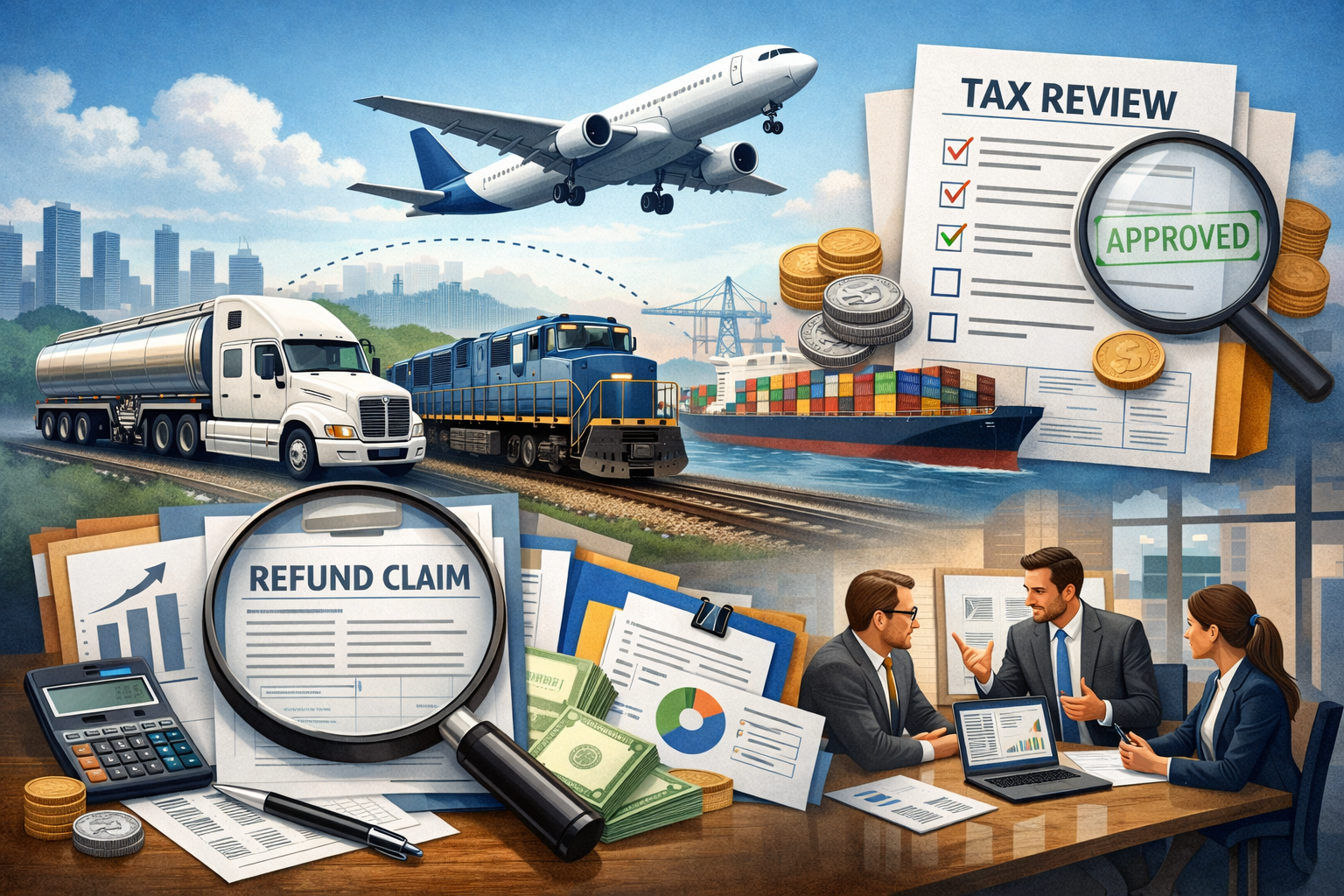
Transportation companies often overpay millions in federal excise and state sales taxes—without ever realizing it. Complex tax rules, evolving exemptions, and inconsistent state interpretations make it easy for refunds to go unclaimed.


Transportation Tax Consulting LLC (TTC) specializes in identifying and recovering those dollars.


Proven Excise & Sales Tax Refund Expertise for Transportation Companies


TTC works exclusively with transportation companies across North America. Our focused industry expertise allows us to uncover refund opportunities that generalist accounting firms frequently miss.


We help clients recover overpaid taxes related to:

  • Fuel and fuel surcharges
  • Equipment, parts, and repairs
  • Leases and rentals
  • Interstate and exempt transportation activities
  • Industry-specific excise tax exemptions


The result is meaningful cash recovery with no disruption to day-to-day operations.


Why Transportation Companies Choose TTC


Industry-First Expertise
Transportation tax rules are uniquely complex. TTC understands how trucking, rail, intermodal, and logistics operations actually work—and how tax authorities review refund claims for these businesses.


Low-Burden, High-Impact Process
Our refund projects are structured to minimize internal workload while maximizing recovery. TTC manages the analysis, documentation, and filing process end-to-end.


Defensible, Audit-Ready Claims
Every refund claim is fully substantiated with detailed transaction support and clear tax logic, reducing audit risk and increasing approval rates.


Customized, Not Cookie-Cutter
Each engagement is tailored to the client’s operations, footprint, and transaction history—ensuring compliant claims and optimal results.


Immediate Financial Benefit
Refund projects generate real cash flow without operational changes, capital investment, or long implementation timelines.


Our Refund Project Approach


Opportunity Assessment – Identify potential refund areas


Detailed Transaction Review – Apply transportation-specific tax analysis


Documentation & Substantiation – Prepare defensible claim support


Claim Filing & Follow-Through – Manage submission and agency interaction


TTC remains engaged through resolution, providing support for agency questions or reviews.


More Than a Refund — A Strategic Partner


Transportation Tax Consulting LLC is more than a recovery firm. We help clients strengthen compliance, reduce future overpayments, and improve internal tax processes through ongoing advisory support.


Our goal is simple: help transportation companies keep more of what they earn—confidently and compliantly.

Share with Us:

Business meeting in a glass office, with a man speaking to two colleagues across a table.
May 5, 2026
Understand economic vs physical nexus, how each triggers sales tax obligations, and strategies transportation companies can use to manage multi-state compliance.
By Matthew Bowles May 5, 2026
For many manufacturers, transportation is viewed as a necessary cost center—an operational function that ensures raw materials arrive on time and finished goods reach customers efficiently. Private fleets are often built to support this mission: dedicated trucks, branded trailers, and drivers aligned with company service standards. The mindset is clear—we are a manufacturer, not a trucking company. But that distinction, while operationally convenient, may be financially limiting. In today’s freight environment—marked by volatility, tightening margins, and increased competition—manufacturers operating private fleets are sitting on an underutilized asset. The question is no longer whether transportation is a cost center, but whether it could be a strategic revenue generator . By choosing not to operate as a for-hire motor carrier, manufacturers may be missing significant opportunities across revenue, cost optimization, tax strategy, and market positioning. Let’s explore what those lost opportunities look like. 1. Revenue Left on the Road The most obvious missed opportunity is direct freight revenue . Private fleets are often underutilized in one or more ways: Empty backhauls Partial loads Idle equipment during off-peak periods Regional imbalances (e.g., strong outbound lanes but weak inbound demand) A for-hire carrier monetizes all of these inefficiencies. A private carrier absorbs them. If your trucks are returning empty 30–40% of the time, that is not just inefficiency—it’s forgone revenue. In a for-hire model, those empty miles could be converted into: Spot market loads Contract freight with complementary shippers Dedicated lanes for third-party customers Even modest utilization improvements can materially change the economics of a fleet. For example, capturing revenue on backhauls alone can offset a significant portion of total fleet operating costs. Bottom line: Private carriers pay for capacity. For-hire carriers sell it. 2. Cost Structure Distortion Private fleets often operate under a different financial lens than for-hire carriers. Costs are embedded within the broader manufacturing P&L, making it harder to: Benchmark transportation performance Identify inefficiencies Optimize pricing per mile or per load Because the fleet is not generating revenue, it is judged primarily on service—not profitability. This leads to several distortions: Over-servicing certain customers without understanding true cost-to-serve Running suboptimal routes to meet internal expectations Lack of pricing discipline compared to market carriers A for-hire structure forces discipline. Every mile has a rate. Every lane has a margin. Without that framework, manufacturers may be: Subsidizing inefficient routes Masking transportation losses within product margins Missing opportunities to rationalize their network 3. Tax Optimization Opportunities One of the most overlooked differences between private and for-hire fleets lies in tax treatment —particularly in areas like fuel tax recovery, apportionment strategies, and indirect tax optimization. For-hire carriers often benefit from: More aggressive fuel tax credit optimization (e.g., IFTA positioning strategies) Better alignment of miles driven with tax jurisdictions Strategic use of leasing structures and equipment ownership models Greater awareness of exemptions and recoverable taxes tied to transportation services Private carriers, by contrast, frequently: Leave fuel tax refunds unclaimed or under-optimized Fail to align operations with tax-efficient routing Miss opportunities to structure transportation activities in a more tax-advantaged way Additionally, operating as a for-hire carrier may open the door to: Different depreciation strategies Sales and use tax advantages in certain jurisdictions Structuring transportation as a separate profit center with distinct tax planning For companies already investing heavily in fleet infrastructure, these missed tax opportunities can compound quickly. 4. Underutilized Data and Pricing Intelligence For-hire carriers live and die by data: Lane pricing Market rates Seasonal demand fluctuations Network optimization Private fleets often have this data—but don’t use it the same way. Why? Because they are not actively participating in the freight market. This creates a blind spot: You may be operating lanes that are highly profitable in the open market—but you never monetize them You may be overpaying for outsourced freight without realizing your own fleet could service it more efficiently You lack real-time pricing benchmarks to evaluate internal decisions By not engaging as a for-hire carrier, manufacturers miss the opportunity to: Develop internal pricing expertise Leverage market rate intelligence Build a more dynamic, responsive transportation strategy 5. Missed Strategic Partnerships Operating as a for-hire carrier naturally leads to relationships : Brokers Shippers Logistics providers Freight platforms These relationships create optionality. Private carriers, however, are largely inward-facing. Their networks are designed around internal needs, not external demand. As a result, they miss opportunities to: Partner with complementary shippers (e.g., filling inbound lanes) Build dedicated capacity agreements Participate in collaborative shipping models Leverage brokerage or 3PL partnerships for overflow or optimization In a tight freight market, these relationships can be invaluable—not just for revenue, but for securing capacity, managing risk, and improving service levels. 6. Asset Utilization and ROI A truck is a capital asset. So is a trailer. So is a driver. The return on those assets depends on utilization. Private fleets often struggle with: Peak vs. off-peak imbalance Seasonal demand swings Regional inefficiencies Because the fleet is designed around internal demand, it cannot easily flex to external opportunities. For-hire carriers, on the other hand: Continuously adjust to market demand Reposition assets dynamically Maximize revenue per tractor and trailer If your fleet is idle even 10–15% of the time, the ROI on those assets is compromised. The question becomes: Why invest in capacity you’re not fully leveraging? 7. Talent and Operational Expertise Operating a for-hire carrier requires a different level of operational sophistication: Dispatch optimization Pricing strategy Customer acquisition Compliance management Private fleets often have strong operational teams—but they are not always trained or incentivized to think commercially. By not entering the for-hire space, manufacturers may be: Limiting the development of transportation leadership Missing opportunities to build internal logistics expertise Falling behind competitors who are evolving into hybrid models There is also a talent attraction angle. Transportation professionals are often drawn to environments where they can: Influence revenue Optimize networks Engage with the broader freight market A purely private fleet may not offer that same appeal. 8. Competitive Disadvantage Some manufacturers are already blurring the line. Hybrid models are emerging where companies: Maintain private fleets for core operations Operate as for-hire carriers on the margin Use brokerage arms to complement physical assets These companies gain: Better cost absorption Increased revenue streams Greater flexibility in managing freight If your competitors are monetizing their fleets while you are not, they may have: Lower effective transportation costs Higher margins More resilient supply chains Over time, that gap can widen. 9. Risk Diversification Transportation markets are cyclical. So are manufacturing sectors. By operating solely as a private carrier, your transportation function is tied entirely to your core business performance. A downturn in manufacturing demand means: Less freight Lower fleet utilization Higher per-unit transportation costs A for-hire model introduces diversification: Revenue from external customers Ability to shift focus based on market conditions Greater resilience during internal slowdowns This can act as a hedge against volatility in your primary business. 10. Barriers—and Why They Exist If the opportunity is so clear, why don’t more manufacturers make the shift? There are real barriers: Regulatory requirements (FMCSA authority, compliance) Insurance complexity Operational changes (dispatch, billing, customer management) Cultural resistance (“we’re not a trucking company”) Risk of service degradation to core customers These are valid concerns. But they are not insurmountable. Many companies address them through: Creating separate legal entities for for-hire operations Starting with limited lanes or backhaul programs Partnering with brokers or 3PLs Gradually building internal capabilities The transition does not have to be all-or-nothing. 11. A Practical Starting Point For manufacturers considering this shift, the first step is not to become a full-scale carrier overnight. It’s to analyze your current network : Where are your empty miles? Which lanes have consistent volume? Where do you have geographic imbalances? What is your true cost per mile? From there, identify low-risk opportunities: Backhaul monetization Dedicated lanes with trusted partners Pilot programs in select regions Even small steps can unlock meaningful value. Conclusion: Rethinking the Role of Transportation The statement “we are a manufacturer, not a trucking company” reflects a traditional view of transportation as a support function. But in today’s environment, that view may be outdated. Transportation is not just a cost to be managed—it is an asset to be optimized. By choosing not to operate as a for-hire motor carrier, manufacturers may be leaving value on the table in the form of: Untapped revenue Inefficient cost structures Missed tax advantages Underutilized assets Limited strategic flexibility The opportunity is not necessarily to become a trucking company—but to think like one . Because the companies that do will not just move freight more efficiently. They will turn transportation into a competitive advantage.
Person in a suit reviewing a document at a desk with a calculator and laptop
April 28, 2026
Avoid IFTA penalties with timely, accurate filings. Learn common delay causes, best practices, and how outsourcing reduces risk and administrative burden.